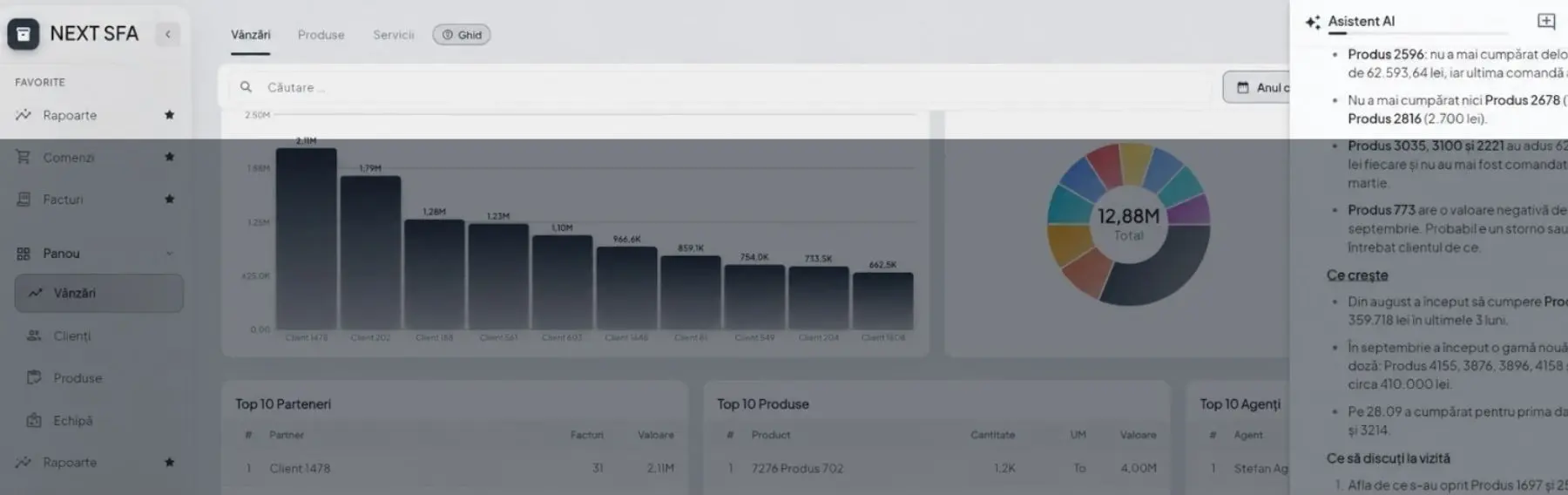

Anyone looking to digitalize business-to-business (B2B) sales sooner or later runs into the same question: B2B portal or SFA solution? The short answer is that they don't compete. They serve two different roles in the same sales process. A B2B ordering portal digitalizes office-based sales, the orders that come in by email and phone or that customers place directly on the platform. Sales force automation (SFA) digitalizes field sales: the order an agent used to write in a notebook while visiting a customer is now placed from an app connected in real time to the ERP system.
The difference is not just a matter of name and interface. What really matters is who the user is, where they work, on which device and what they need at that moment. That directly shapes which features they use and which application needs to be licensed. In practice, these are two usage patterns within the same sales activity.
That's why we offer different solutions for these roles: NEXT B2B for back-office sales departments and NEXT SFA for sales agents working in the field.
The B2B portal: selling from the office, with the customer placing the order
A B2B portal is built for two groups of users, both "stationary": the customer, who orders on their own, and the sales department, which runs the sales process from the office. No travel is involved. It is the channel through which a company gives its partners self-service access to the catalog, real stock, negotiated prices and order history, without a phone call or email for every order.
In practice, the portal covers two separate work areas:
- The customer area: a personalized catalog, one-click ordering, balance and credit limit visible in real time, promotions applied automatically, live order status (Order → Sent to ERP/WMS → Picking → Delivery) and direct messaging on every order.
- The sales department area: sales dashboards, automatic detection of declining customers, an RFM profile (score) for each partner, management of commercial policies, purchasing, AR aging and access rights administration.
In other words, the B2B portal moves predictable order volume (the orders customers would have placed anyway, just by phone) onto an automated channel, while giving the sales department a complete picture of what is happening, without waiting for the end-of-month report. Both customers and sales staff usually work from a computer or tablet in an office setting. Access from any device is available, but it is not the core of the solution.
SFA: selling in the field, with the agent at the customer's site
SFA (sales force automation) solves a completely different problem: that of field sales agents, the people who physically travel to each customer to take the order. This is the classic model in FMCG and traditional distribution, and its limits come not from the model itself but from the tools: the order book, the phone and the agent's memory of what the customer bought last time.
An SFA solution replaces this set of manual tools with an app used mainly on the agent's mobile phone. The smartphone effectively becomes their work terminal on the road, between one visit and the next, with direct access (sometimes offline too) to the ERP and, where needed, the WMS. Unlike the B2B portal, which is naturally used in a browser at the office, here mobile is not one option among many but the main working environment, because a field sales agent doesn't carry a laptop, just the phone in their pocket. At every visit, the agent sees exactly what is in the central system (not an approximate version, but real stock and prices) and can place the order on the spot, with no manual re-entry later. On top of that come components specific to field work:
- A pre-visit brief, with the customer's risk score and what to propose during that visit;
- Commercial policies visible instantly: price lists, threshold and discount offers, quantity promotions;
- Cross-sell recommendations, calculated automatically from the products the customer doesn't buy yet;
- On-the-spot payment collection, allocated to the customer's open invoices;
- Routes and visits, with daily route planning;
- Sales targets tracked over any period: monthly, quarterly, yearly.
The key difference from the B2B portal is the one in the title: here the order is not placed by the customer but by the agent, on the customer's behalf, and the whole logic of the solution is built around the agent's productivity in the field, not around customer autonomy.
Different users, different licensing
Because the roles are different, the access needs are different too. A customer ordering on their own from the portal needs one kind of account, focused on the catalog, cart and order status. A field sales agent needs an entirely different kind of access (routes, visit briefs, collections, targets) designed for a mobile phone. A user in the sales department needs a third perspective: dashboards, commercial policies, user and rights administration.
That's why licensing a B2B portal and an SFA solution can't follow a single formula. It has to reflect each role: how many customers have self-service access, how many agents use the field app, how many back-office users run the platform. In both cases, the subscription cost takes into account the number of users per role, the number of customer companies defined in the platform, the number of products managed and the number of transactions processed each month. But the role structure is fundamentally different between the two solutions, because each one solves a different problem.
| B2B portal | SFA (sales force automation) | |
|---|---|---|
| Who uses it | The customer (self-service) and the sales department | Field sales agents, visiting customers |
| Where the order is placed | The customer orders on their own, from a browser or phone, at any time, or the sales department enters it directly. | The agent orders on the customer's behalf, on site |
| Core role | Autonomy for the customer + control for the sales department | Productivity and information for the field agent |
| What it solves | Removes phone and email from recurring orders | Removes the order book and manual re-entry |
| Key data shown | Catalog, negotiated price, stock, balance, order history | Pre-visit brief, risk score, cross-sell, commercial policies |
| Extra component | Sales department dashboard: sales, RFM, retention, purchasing | Routes and visits, on-the-spot collections, sales targets |
| Main working environment | Browser, in the office, on a computer or tablet | Mobile phone app, mainly in the field |
| Usage model | Self-service, no human involvement in each order | Agent-assisted, with direct customer interaction |
The two solutions complement each other
In practice, many B2B companies need both: customers who prefer to order on their own, and sales agents who keep visiting certain accounts in the field with the app on their phone. That's why NEXT B2B and NEXT SFA are built to work natively on the same backend: a single source of truth for stock, prices and commercial policies, whether an order comes from the portal or is taken by an agent at the customer's site.
Both products are now available for beta testing and will be commercially available starting in September.
If you'd like a more detailed presentation of NEXT B2B and NEXT SFA, possibly tailored to your business or even using your own data, you can reach us at office@nextisolutions.ro.