
More and more often, our clients and prospects ask us how they could use AI in their business. Everyone has heard of ChatGPT, Gemini or Claude, and some people already use these tools at work, but mostly on an individual level.
From these conversations, we see two main groups of people: some are very enthusiastic and would like to do everything with AI, while others still ignore it. The reality is somewhere in between, and a few points deserve a closer look. For one thing, there is a big difference between using ChatGPT for personal tasks and having an AI agent built into your ERP system that automates specific activities.
The takeaway is this: AI cannot do everything yet, and many tasks still need human supervision. At the same time, it cannot be ignored. Companies that refuse to use it will gradually fall behind.
It is a new technology, but a revolutionary one, with huge potential to change the way we work.
Any employee can make their job easier by using public AI tools for tasks where they lack specific knowledge (for example, complex operations in an Excel file or the automatic translation of documentation written in Swedish) or where they lack time (putting together a complex quote or the paperwork for a tender). But AI is now moving fast into business applications (ERP, CRM, WMS), where it can significantly raise the level of automation and efficiency.
At this level, there is no room for tolerance or approximation. Processes are standardized and exact, so the technology has to be precise as well. Although AI agents get most of the attention, RPA (Robotic Process Automation) is in many cases a far more realistic and advisable option.
- RPA is a software robot that mimics human actions and carries them out exactly as instructed.
- AI agents are much more autonomous and make decisions with a higher degree of independence, which sometimes requires supervision from experienced people.
Then again, the same need for supervision exists for human employees, who rarely have complete freedom of decision, whether it is granting a discount or raising a customer's credit limit.
AI features in CRM and ERP
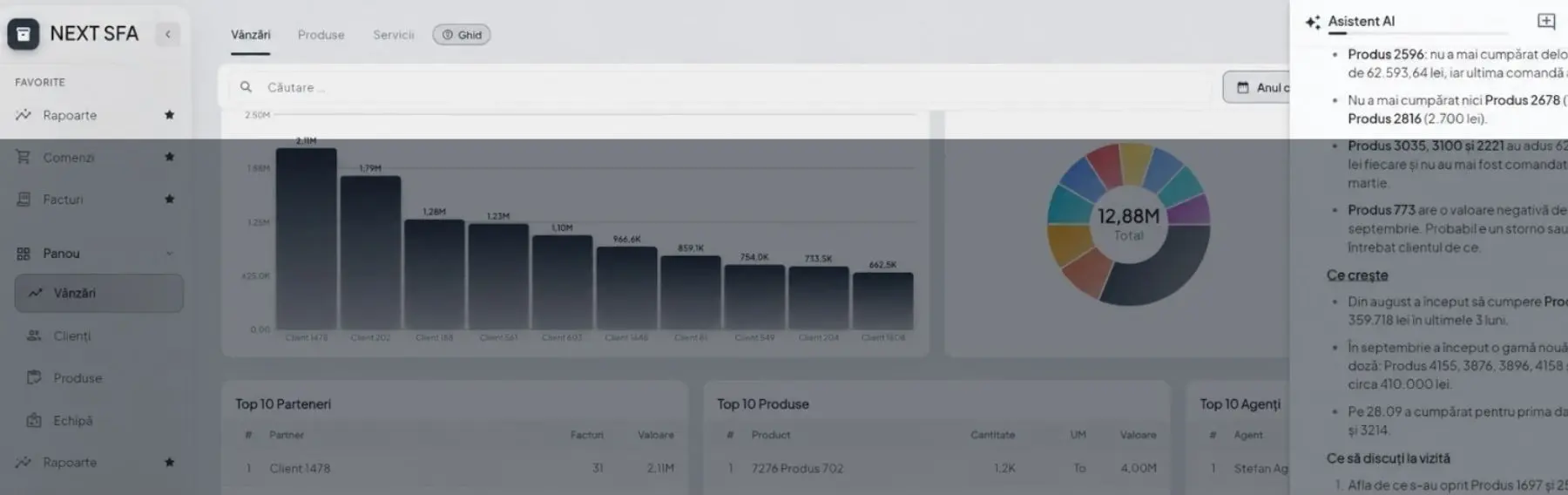
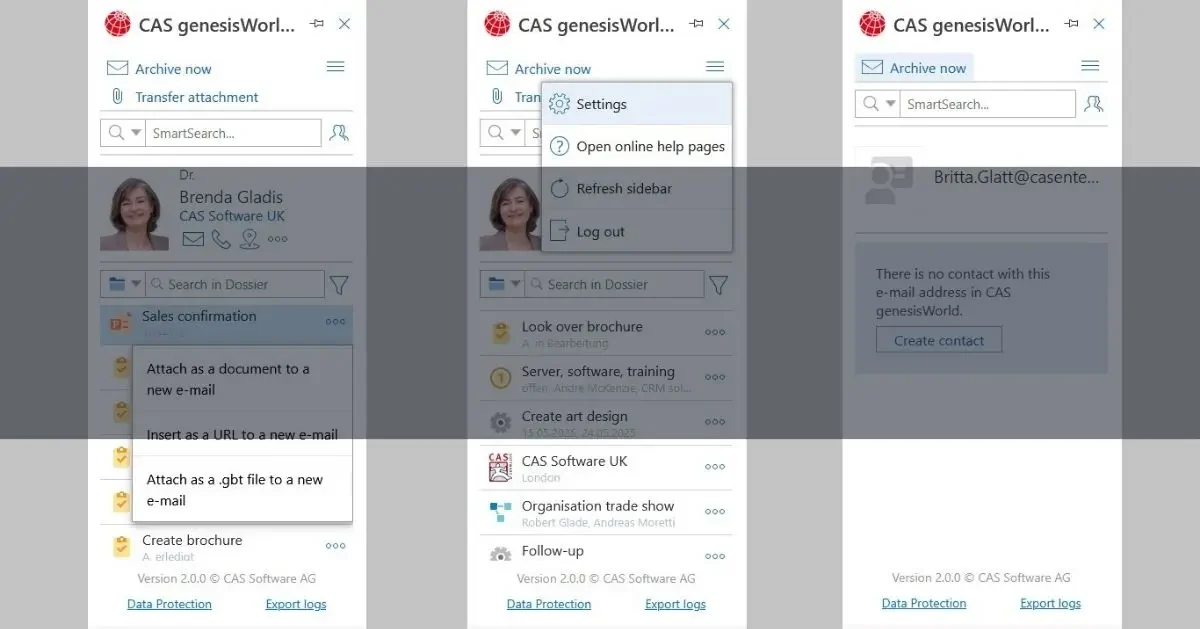
CAS Software was one of the first companies to build AI into its CRM systems. This brought intelligent virtual assistants that help employees, as well as workflow-level automation. Other AI-based features include:
- Dynamic customer segmentation: automatic grouping by criteria such as purchase frequency, revenue, satisfaction or products bought.
- Individual product suggestions: personalized recommendations for existing customers based on their history.
- Product selection for marketing campaigns: proposing the target group based on historical sales data.
- Text generation: automatic creation of product descriptions or sales messages, which are then approved by employees.
- Assisted communication: individual emails generated from the communication history with each customer.
- Support chatbots: learning algorithms used for self-service and advice.
- Sales probability calculations and price optimization.
The picture is similar in ERP systems. Our partners at WinMENTOR introduced the virtual assistant MAIA, designed to make working with the system easier. Built on AI, MAIA understands natural language and offers conversational support, pulling information directly from the system documentation.
Even so, at ERP level, RPA (software robots) remains a very practical choice: it handles exact workflows consistently, where there is no room for error. Key capabilities include:
- Document processing: automatic generation of consumption notes, labor reports, scrap notes and transfers.
- e-Factura and e-Transport integration: automatic connection to Romania's national e-invoicing and goods-transport reporting systems, to simplify legal compliance.
- Automated inventory management: automatic stock reservations based on replenishment needs.
- Automated reporting: reports generated at set times and sent to decision makers.
In both CRM and ERP, things are moving fast, and we expect the vendors of these solutions to release new AI-based features in the near future. We also have high expectations for SOFTONE ERP, which will launch its new version in the first half of this year.
"The AI problem" as we see it at NEXT
Because every company runs its business in its own way, AI cannot be used in a standardized way. There are specific nuances that cannot be left 100% to an AI agent without a well-defined context.
At Next iSolutions, we already use AI to speed up our own project development, and we want to pass these benefits on to our clients. However, we know that AI is not "one size fits all". From retail to manufacturing or distribution, every organization has its own pace. For our developers, it is important to understand the nuances of each client's business and their specific requirements. We can build automations or AI features for a wide range of actions, from checking a balance to automatically creating a purchase order. We have the technology; the challenge is how to use it so the task is carried out correctly. Some tasks can be automated 100%, others only 70-80%, with the rest needing human intervention or supervision. Rather than a flood of wrong orders that generate costs and frustration, it is better to have a partially automated process that is consistent and correct in the end.
Our starting point is that AI is currently an extremely powerful and autonomous tool, but one that must be supervised, especially in B2B environments, so that it works efficiently and adds value instead of causing turbulence in the business. Whether you want to streamline your supply chain or transform your customer service, we make sure our solutions, from chatbots and software robots to AI, adapt to your business, not the other way around.
So don't ask yourself "how do we implement AI", because AI is not implemented as a whole. Ask instead which activities, operations or tasks you could automate and optimize with Artificial Intelligence. Once you have identified such a case, challenge us to a conversation about how we can put it into practice.