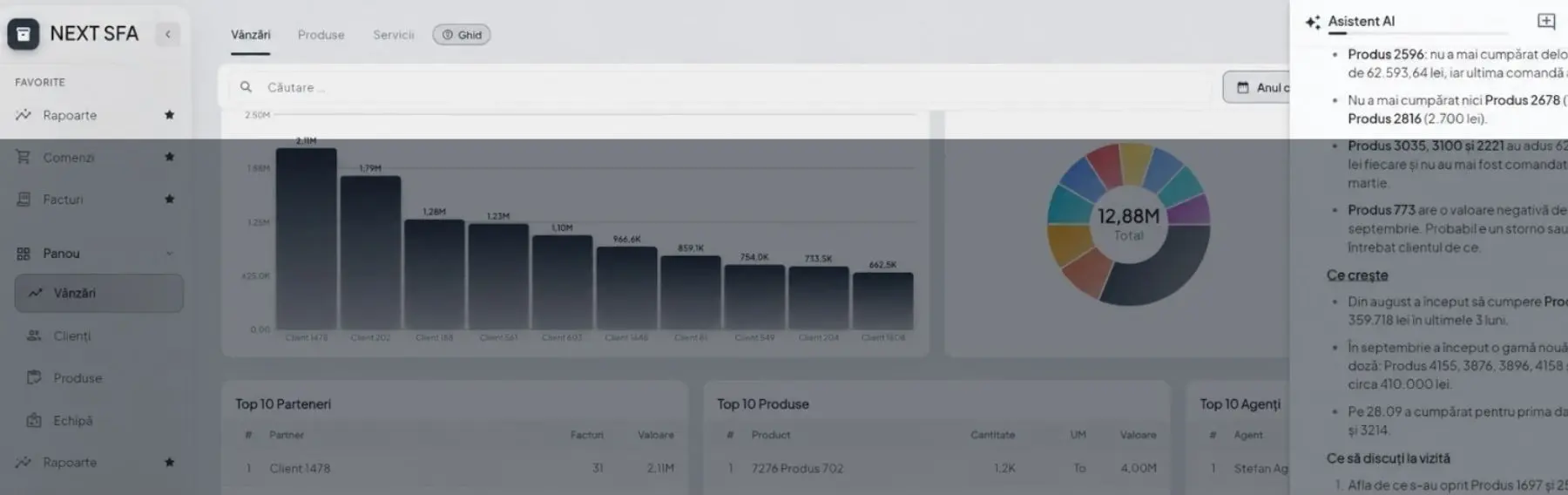

In Romania, offices full of paper and binders are still a common sight. That's because many companies still don't have an ERP system (Enterprise Resource Planning) and run on manual processes, paper documents and disconnected software, possibly Excel. These methods have become extremely inefficient given what today's market and workforce demand.
Every company today, whatever its size or sector, struggles with correlating data from multiple sources, limited visibility over transactions, slow and error-prone workflows, a lack of connection between departments, cybersecurity threats and more. This is where ERP software comes in: it addresses all these challenges by bringing all data and processes together in a single integrated platform, for efficient data management and access to information in real time.
That doesn't mean an ERP system will rid you of all paperwork overnight, but it helps you move to an organized, digital way of working that, over time, depends less and less on paper and on being physically present in the office.
What is an ERP system?
An ERP (Enterprise Resource Planning) system is an integrated software platform that lets you manage all business processes in one place, including accounting, human resources, manufacturing, distribution, marketing, sales and supply chain management. The ERP brings all these functions together in a single solution, so teams can access and share data efficiently. In practice, an ERP system is not a single program but a suite of applications or modules that work together and collect information from different departments, built on a centralized database.
ERP systems can be classified in several ways, depending on the criteria. Here are the main types of ERP:
- By deployment model:
- On-premise ERP: installed and managed on the company's own servers.
- Cloud ERP: accessed over the internet and hosted by the solution provider (SaaS, Software as a Service).
- Hybrid ERP: combines on-premise elements with cloud solutions for greater flexibility.
- By business size and type:
- ERP for large enterprises: complex, customizable solutions (e.g. SAP S/4HANA, Oracle ERP Cloud).
- ERP for SMEs: more affordable, with the essential features (WinMENTOR ENTERPRISE, SOFTONE).
- ERP for startups: easy-to-implement, cloud-based, low-cost solutions.
- By industry:
- General-purpose ERP: applicable across many fields, with standardized modules.
- Specialized ERP: built for specific industries (manufacturing, retail, construction, healthcare and so on).
What modules and features does an ERP offer?
Since every business is unique, with its own requirements and size, an ERP system is generally not an off-the-shelf product: it lets you choose only the modules that best match your goals. The modular design of ERP makes it quick to adjust to a business's changing needs, and that is one of the reasons this software is so popular. A company can buy only the modules relevant to its business model and its specific challenges. As the business grows, it can add new ERP modules to meet new requirements.
The major advantage of a modular ERP system is that a company can extend its functionality without replacing the whole system. There is no need to implement a new ERP (often a complicated and expensive process) as long as you choose a reliable ERP vendor that offers a wide range of modules. Read on for a selection of the most widely used modules:
Core (essential) modules:
- Finance and accounting: accounting, invoicing, budgets, audit, financial reports
- Human resources (HRM): employee administration, payroll, recruitment, performance reviews
- Inventory and warehouse management (WMS): inventory management, product tracking, stock optimization
- Purchasing (Procurement): requests for quotation, purchase orders, supplier relationships
- Sales and CRM: managing quotes, orders, customer relationships and sales activities
Advanced (optional) modules:
- Manufacturing (Manufacturing/Production Planning): production planning, raw material management, quality control
- Projects (Project Management): planning, tracking and managing projects and allocated resources
- Logistics and distribution: managing delivery orders, transport and routing
- Maintenance (Maintenance Management): planning and tracking maintenance of equipment or machinery
- E-commerce: integrating online orders, synchronizing stock and managing deliveries
Advanced modules for strategic decisions:
- Business Intelligence (BI): data analysis, advanced reports, forecasting and predictive modeling
- Supplier Relationship Management (SRM): supplier collaboration and evaluation
- Governance, Risk and Compliance (GRC): regulatory compliance and risk management
- Document Management: archiving, managing and sharing electronic documents
- Process automation (Workflow Automation): defining and automating workflows across departments
All modules can be customized to each organization's specific needs.
Why implement an ERP system? 10 benefits for your business
In 2023, the use of ERP suites was already well established among EU organizations, ranging from 37.9% for small companies to 86.3% for large ones, according to Eurostat data. There are many reasons for this choice. An ERP system offers a number of key benefits that make it a popular solution for most modern businesses:
- Centralized data and process automation. All information is stored in a single platform that every department can access. Repetitive tasks are automated, reducing errors and saving time.
- Real-time visibility and mobility. Gives you access to up-to-date data for fast decisions, wherever you are, through web or mobile apps.
- Operational efficiency and lower costs. Optimizes workflows and improves team productivity. Automating and integrating processes cuts administrative and operating costs.
- Scalability and flexibility. The system adapts easily as the business grows or new requirements arise.
- Advanced reporting and predictive analytics. Automatically generates detailed reports that help you analyze business performance. Uses historical data to make forecasts and support strategic decisions.
- Collaboration across departments and stronger internal control. Improves communication and cooperation between teams, wherever they are. Lets you apply clear rules and policies for managing data and access.
- A better customer experience and customer relationship management. Centralizes customer information and supports more effective communication. More efficient processes and centralized data lead to faster deliveries and better service.
- Traceability and compliance. Tracks every step of your processes and helps you comply with regulations.
- Data security. Protects company information with encryption and access control.
- Optimized resource planning. Lets you allocate raw materials, time and staff efficiently.
ERP systems from Next iSolutions
Next iSolutions gives you access to two of the most modern, capable and easy-to-use ERP systems on the market.
SOFTONE ERP is a modular, flexible solution that automates and simplifies all of a business's operational processes, with a high level of transparency, control and productivity. With more than 32,000 customers and 130,000 end users worldwide, the platform brings together in a single system modules for general ledger and management accounting, manufacturing, sales and purchase processing, customer and supplier management, and fleet management.
Available both on-premises and in the cloud, the solution adapts easily to any type of company, with extended mobility through web and mobile apps, lower costs and fast implementation. The latest version, SOFTONE Cloud ERP Series 6, is 50% faster and 100% more intuitive, and includes advanced features such as Business Robotics, BI Data Lake, SAF-T, e-Factura (Romania's national e-invoicing system) and e-Transport. With automatic updates and a scalable architecture, SOFTONE ERP supports continuous business growth with no additional investment in IT infrastructure.
WinMENTOR Enterprise, on the other hand, is one of the most popular ERP systems in Romania, with more than 45,000 users nationwide. Built on the experience of a team of specialists with more than 30 years in the field, this integrated ERP system offers a complete solution for managing accounting, inventory, customer and supplier relationships, and treasury. WinMENTOR Enterprise can generate accounting entries on several charts of accounts at the same time, automate document posting and efficiently manage EU-funded projects and expenses. The system also automatically generates tax returns (300, 390, 394) and the mandatory financial statements, simplifying financial processes.
Easy to customize with 22 additional modules, WinMENTOR lets you add CRM, EDI, BI, cash register management and much more, covering the needs of retail, manufacturing, restaurants, warehouses, fleet management and online retail businesses. Built on Oracle and PostgreSQL database technology, WinMENTOR delivers performance, security and scalability. It is also available in English, Hungarian and Italian, and makes it easier to work with e-Factura, e-Transport and SAF-T (D406) filing. The user-friendly interface and communication features make collaboration between departments and users easier, and advanced security protects your data and limits access to sensitive information.
Contact Next iSolutions for advice on choosing the most effective ERP system for your business's unique requirements.